The 221B Daily

A new edition from Baker Street every morning.

Friday, 6 November 2026 | Difficulty V

The Case of the Bishop's Telegram

A bishop receives a typewritten telegram demanding two hundred pounds, threatening to expose a 15-year-old colonial indiscretion. He has five days. He has only the police.

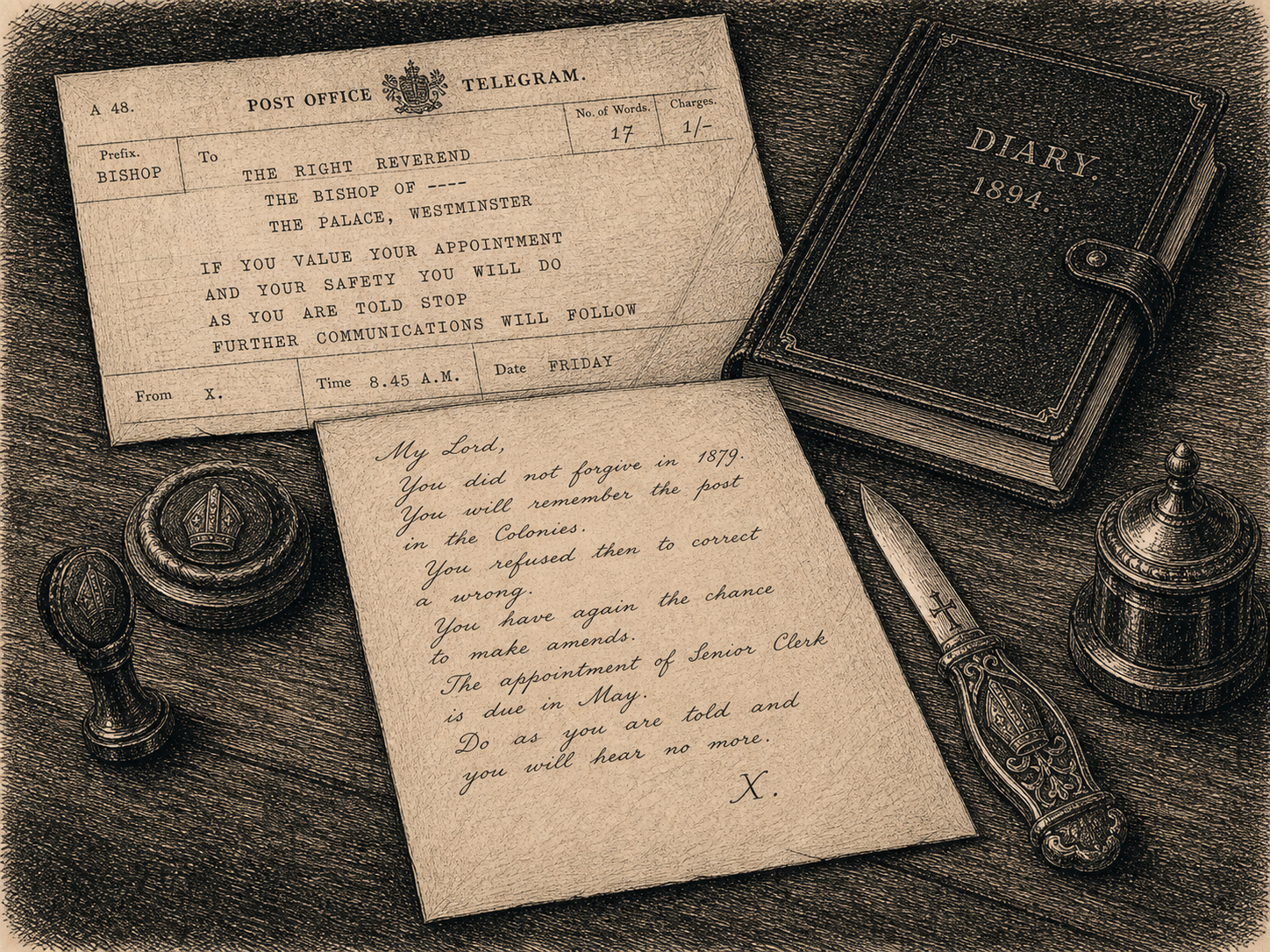
Engraved key object plate for The Case of the Bishop's Telegram.
Narrated by Dr Watson — the case as it stood before us
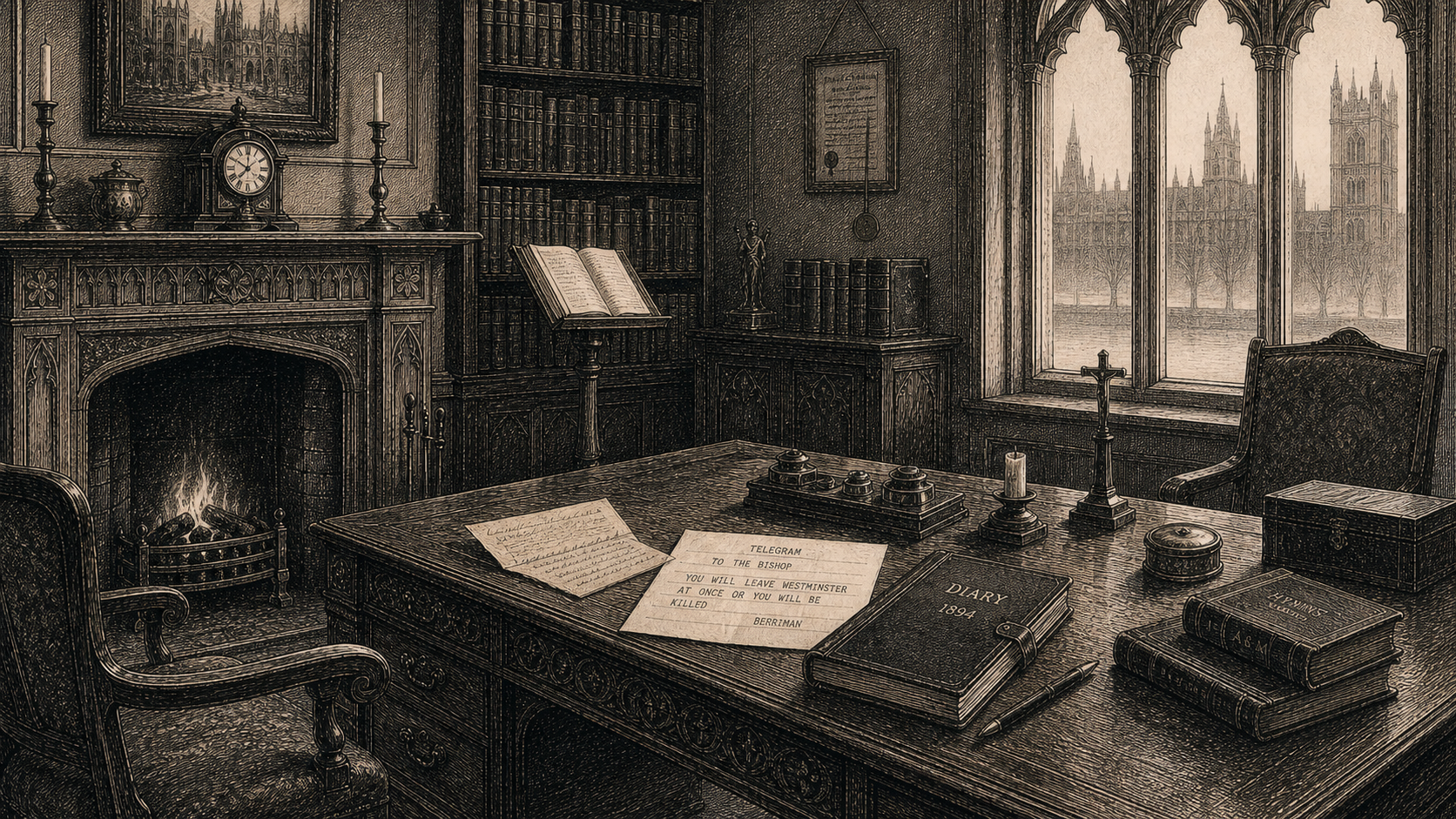
Victorian newspaper-style illustration for The Case of the Bishop's Telegram, set at The bishop's residence, Westminster.

Section I

The Scene

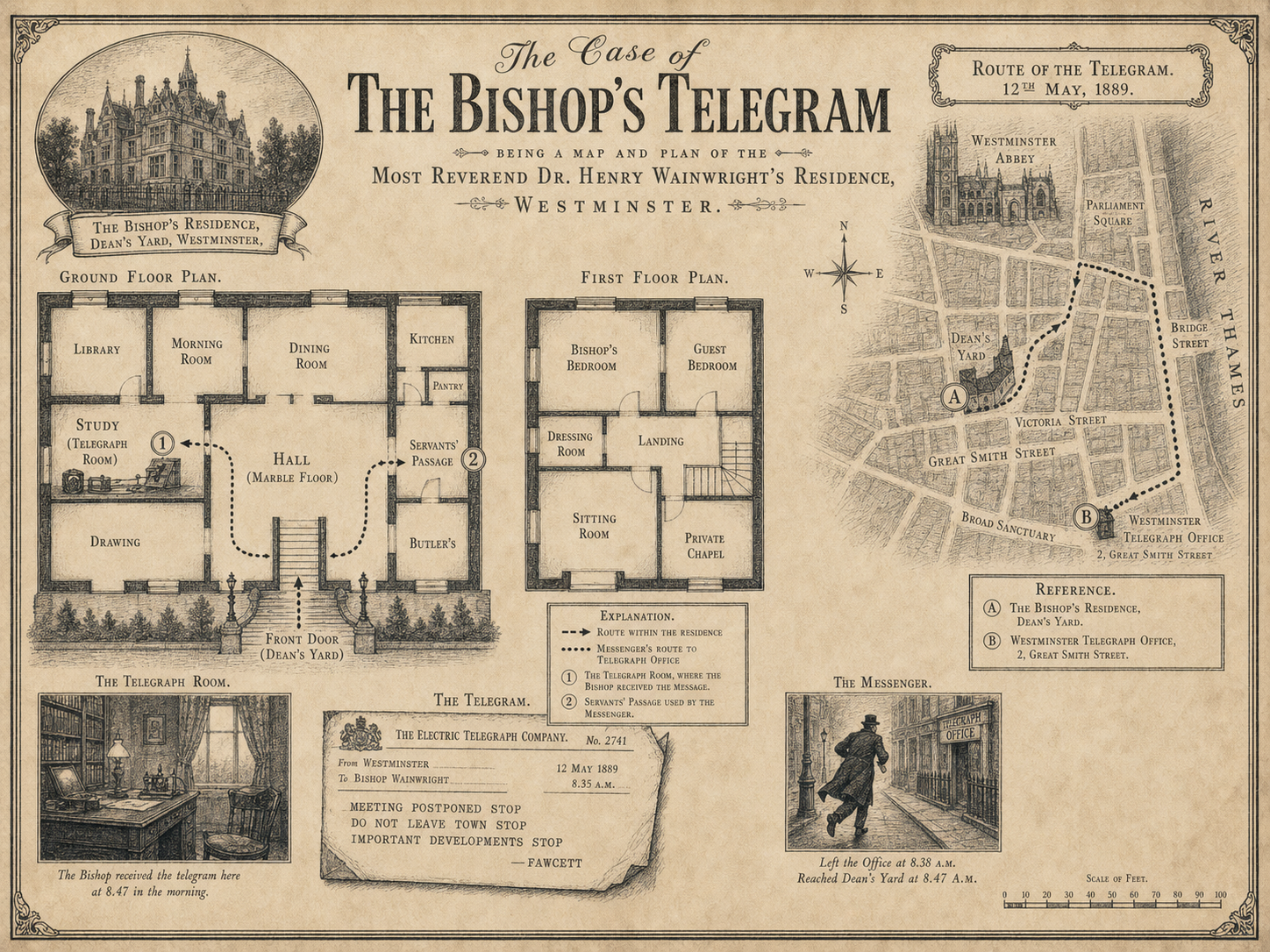
Hand-drawn case map for The Case of the Bishop's Telegram, showing The bishop's residence, Westminster.
The ground in question.
Setting
The bishop's residence, Westminster
Time
Friday morning, third Friday of March 1894
Weather
A cold spring; the river-fog low; the cathedral bells at the half-hour
Atmosphere
A bishop's panelled study; tall windows over the cathedral close; a black-bordered diary on the desk; the smell of beeswax and old hymn-books.

Section II

The Suspects

  • The Reverend Mr Pelham

    Bishop's chaplain, recently arrived

    A young, reformist clergyman of thirty, two months in the post, with strong views upon colonial missions and a sharp tongue at the chapter-meeting. The bishop had not yet warmed to him.

  • Mr Spurway

    Verger, twenty years

    A heavy, slow-spoken man of fifty-five, who had been passed over five years ago for a deputy-vergership at the cathedral. He had a private grievance against the bishop and a patient memory.

  • Mrs Hatherly

    Housekeeper, twelve years

    A composed widow of fifty-eight, whose son was a colonial-government clerk in the very territory of the bishop's old indiscretion of '79. The son's preferment was on the line: a small post he had hoped for as senior clerk was due to be filled in May.

  • The Reverend Mr Pelham (the elder)

    Former curate of the bishop, retired in Brighton

    A weathered clergyman of seventy, who had served with the bishop in '79 and remembered the matter. He had been at Brighton for ten years and had not been to London in any of the past three years.

Section III

The Evidence

  1. The threatening telegram

    The telegram was typewritten on a Post Office form posted from a Westminster office at six o'clock on Thursday. The threat was in plain English; the demand was for two hundred pounds in Bank of England notes by Wednesday's post.

  2. The threatening letter's particulars

    The letter that followed the telegram named the colonial post - a junior diocesan secretariat in '79 - and mentioned, in particular, the senior-clerk's appointment due to be filled in May, with the warning that any inquiry following the publication of the matter would close the appointment to anyone of the household's connection.

  3. Mr Spurway's deputy-vergership

    The verger's grievance over his passed-over place five years ago was real, but he had not, by the cathedral's testimony, written so much as a complaint to the chapter; he kept his grievance in private and at his hearth.

  4. Mrs Hatherly's son's appointment

    Mrs Hatherly's son, Mr Hatherly, was a colonial-government clerk at the very territory of the bishop's '79 indiscretion. His application for the senior clerkship was due to be considered in May. The matter, on enquiry through a friend at the Colonial Office, had hung upon a small private recommendation from the bishop's office which the bishop had not yet given.

  5. The Westminster typewriter

    Holmes asked, at the Westminster Post Office, for the typewriter used for outbound telegrams. The form had been typed at the public typewriter at the office's counter - a steady machine in good order, but one that anyone might use at sixpence the application.

Section IV

Statements & Testimony

  • Mrs Hatherly

    Housekeeper

    “"I have served the bishop these twelve years, sir. The matter of '79 I knew of from his own quiet word at supper, when his lordship was sorrowful one evening. I - I am very anxious for my boy's appointment. The Colonial Office asked his lordship for a recommendation in February; the recommendation has not yet been written. I do not know how to ask for it."”

  • The Reverend Mr Pelham

    Bishop's chaplain

    “"I have my views upon colonial missions, Mr Holmes, and his lordship knows them. I have not been at the Westminster Post Office these three months. I should not have done so wicked a thing as a typewritten telegram against a fellow churchman."”

Section V

Your Verdict

Three picks render a verdict. Name the culprit, choose the method, and nail the keystone clue. We score all three — partial credit if you got the culprit but missed the method, full credit only if you got Holmes’s exact reasoning.

1. Name the culprit
2. Choose the method

Which of these accounts of the deed best matches the evidence?

3. Pick the keystone clue

Of all the evidence above, which single piece nails the case?

Choose a culprit, a method, and a keystone clue to render your verdict.