The 221B Daily

A new edition from Baker Street every morning.

Wednesday, 10 June 2026 | Difficulty III

The Case of the Naval Officer's Code

A junior naval officer's locked desk has been rifled and a draft signal-code is gone. He has the only key. His superior speaks of court-martial.

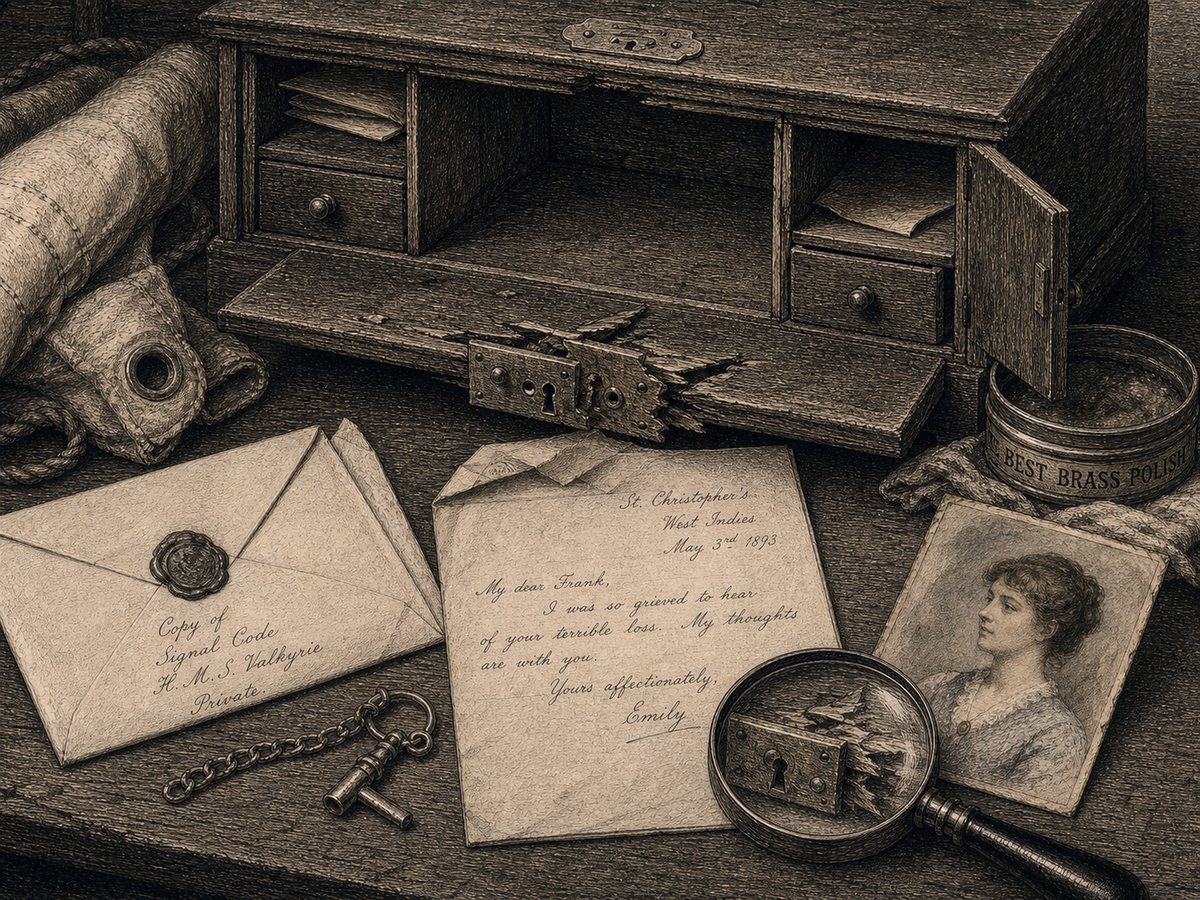
Engraved key object plate for The Case of the Naval Officer's Code.
Narrated by Dr Watson — the case as it stood before us
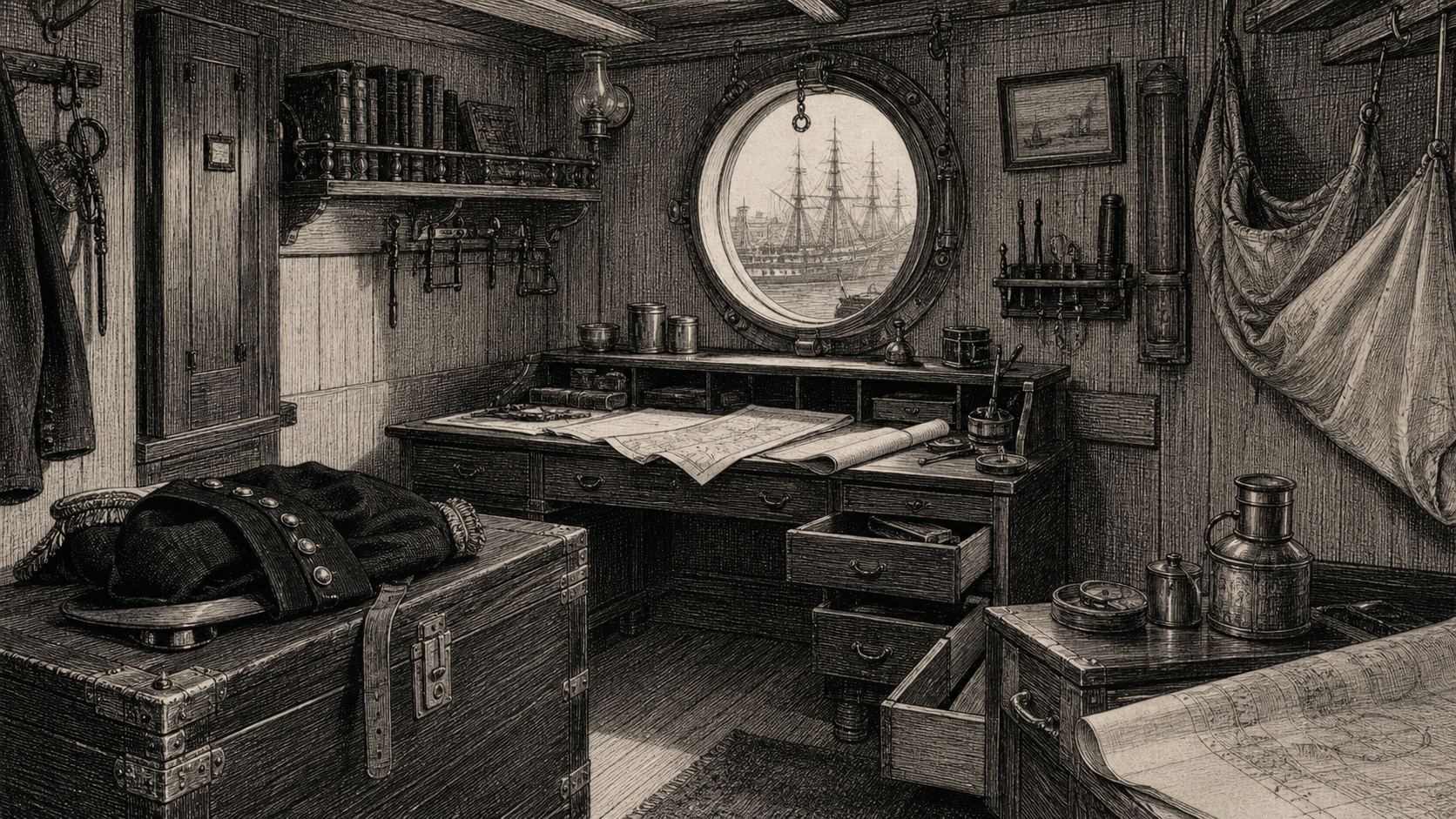
Victorian newspaper-style illustration for The Case of the Naval Officer's Code, set at Lieutenant Marsh's quarters, HMS Excellent, Portsmouth dockyard.

Section I

The Scene

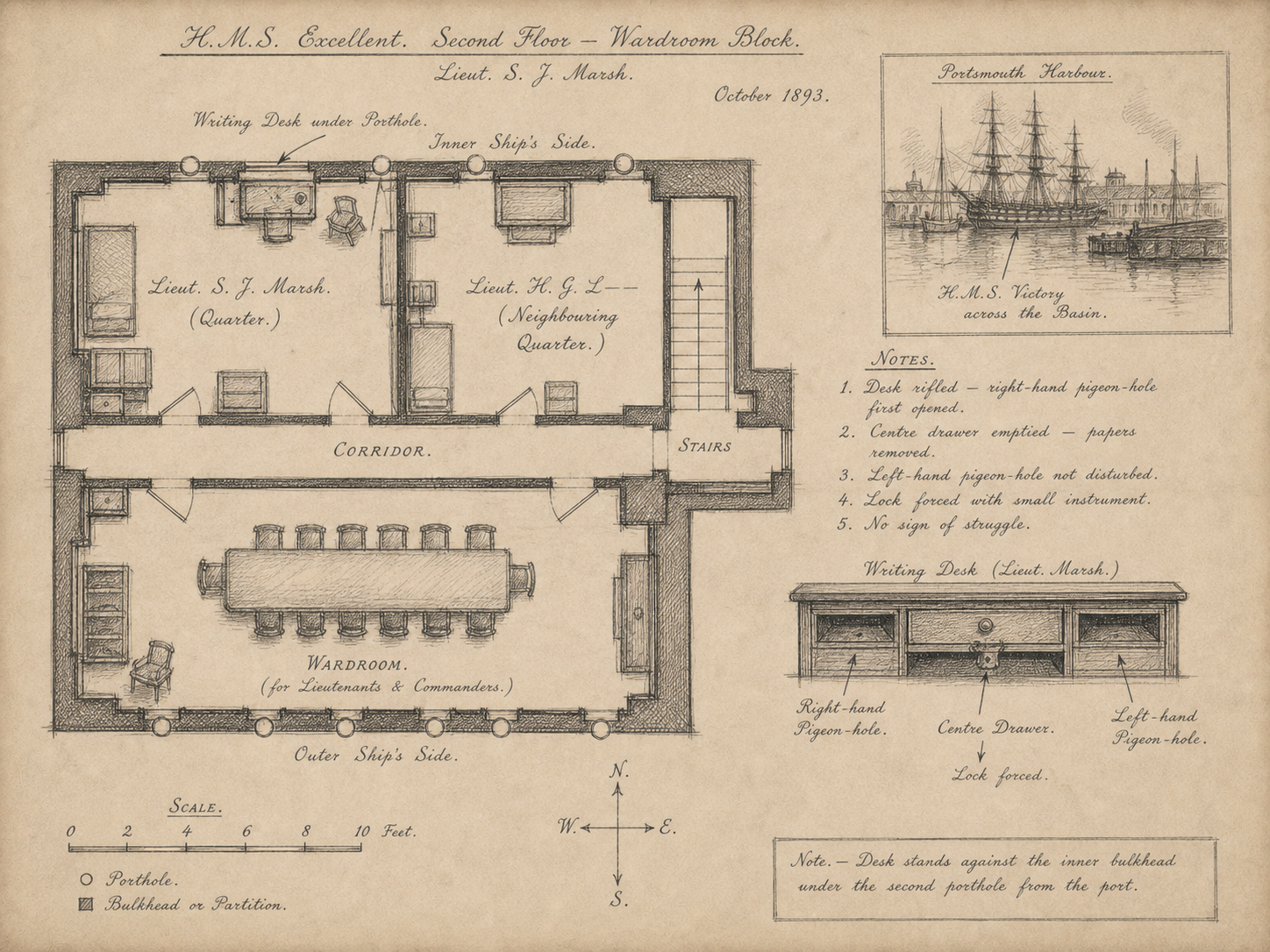
Hand-drawn case map for The Case of the Naval Officer's Code, showing Lieutenant Marsh's quarters, HMS Excellent, Portsmouth dockyard.
The ground in question.
Setting
Lieutenant Marsh's quarters, HMS Excellent, Portsmouth dockyard
Time
Wednesday morning, third Wednesday of October 1893
Weather
Cool; a light wind off the harbour; gulls overhead
Atmosphere
A small wardroom-quarter with a sea-going chest and a writing-desk under the porthole; the smell of brass-polish and sail-canvas; the masts of HMS Victory visible across the basin.

Section II

The Suspects

  • Lieutenant Henry Marsh

    Junior naval officer; the client

    A precise, anxious officer of twenty-eight, three years at the gunnery school, who had drafted the signal-code in his own hand over the past six months and held the desk-key on his watch-chain. He had recently been seen in low spirits.

  • Captain Frowde

    Marsh's superior at Excellent

    A grave, careful captain of fifty, much trusted in the service, who had himself authorised the code's drafting and stood, on its loss, to face questions from the Admiralty Office.

  • Mr Plumtree

    Marsh's brother-in-law; a journalist for the Mall Gazette

    A worldly, sharp-tongued man of forty, married to Marsh's elder sister, recently in Portsmouth and disposed to question the Lieutenant about a matter of three years' standing in the West Indies. He had the easy manners of a man who knew most of London's secrets and was not above using them.

  • Sub-lieutenant Pole

    Marsh's neighbour at Excellent; borrowed the desk on Saturday

    A bluff young sub-lieutenant of twenty-three, who had borrowed Lieutenant Marsh's desk for a half-hour's letter-writing on Saturday, with the lieutenant's express permission, and had returned the key at five.

Section III

The Evidence

  1. The forced lock

    The desk's lock had been forced from the front, the brass plate prised outward and the housing splintered. Holmes examined the splintering with his glass; the work had been done with a flat instrument applied at the very angle a man would attempt who had to know the shape of his target unseen.

  2. The intimacy of the rifling

    The contents of the desk had been rifled with a sure hand: the right-hand pigeon-hole opened first, the left untouched, the centre drawer emptied of papers but not of the watercolour Marsh kept of his sister. Only the man who knew which drawer held the code-draft, and which the watercolour, would have searched in this order.

  3. Mr Plumtree's recent enquiries

    The brother-in-law had been heard at the wardroom on Sunday evening to ask, with apparent idleness, about the stations of the Caribbean squadron in '90. The question had been turned aside; he had not pressed it.

  4. The signal-code itself

    The draft signal-code, when sought in the desk, was gone. A search of the lieutenant's own quarters by Captain Frowde found a clean copy of the same in a sealed envelope upon the inside of the lieutenant's mattress.

  5. An old letter from the West Indies

    In the rifled desk's centre drawer, beneath the displaced papers, lay an old envelope addressed to Lieutenant Marsh from St Christopher's, dated 1890. The flap had been opened recently; a faint freshness in the gum belied its years.

Section IV

Statements & Testimony

  • Sub-lieutenant Pole Reliable

    Neighbour at Excellent

    “"Marsh lent me the desk on Saturday afternoon, sir, for half an hour. I locked it again at five and returned the key. He was at the gunnery school; I went up to the wardroom for tea. I saw nothing irregular."”

  • Captain Frowde Reliable

    Marsh's superior

    “"Lieutenant Marsh has been a careful officer, Mr Holmes. The signal-code was at his work these six months. Mr Plumtree I have not met; the wardroom mess speaks of him as a London journalist. The matter weighs heavily upon Marsh; he is in a state I have not seen before."”

Section V

Your Verdict

Three picks render a verdict. Name the culprit, choose the method, and nail the keystone clue. We score all three — partial credit if you got the culprit but missed the method, full credit only if you got Holmes’s exact reasoning.

1. Name the culprit
2. Choose the method

Which of these accounts of the deed best matches the evidence?

3. Pick the keystone clue

Of all the evidence above, which single piece nails the case?

Choose a culprit, a method, and a keystone clue to render your verdict.