The 221B Daily

A new edition from Baker Street every morning.

Tuesday, 9 June 2026 | Difficulty II

The Case of the Conductor's Missing Baton

An Italian conductor's silver-chased baton — a royal gift — vanishes from his dressing-room minutes before the platform. Five people had business backstage.

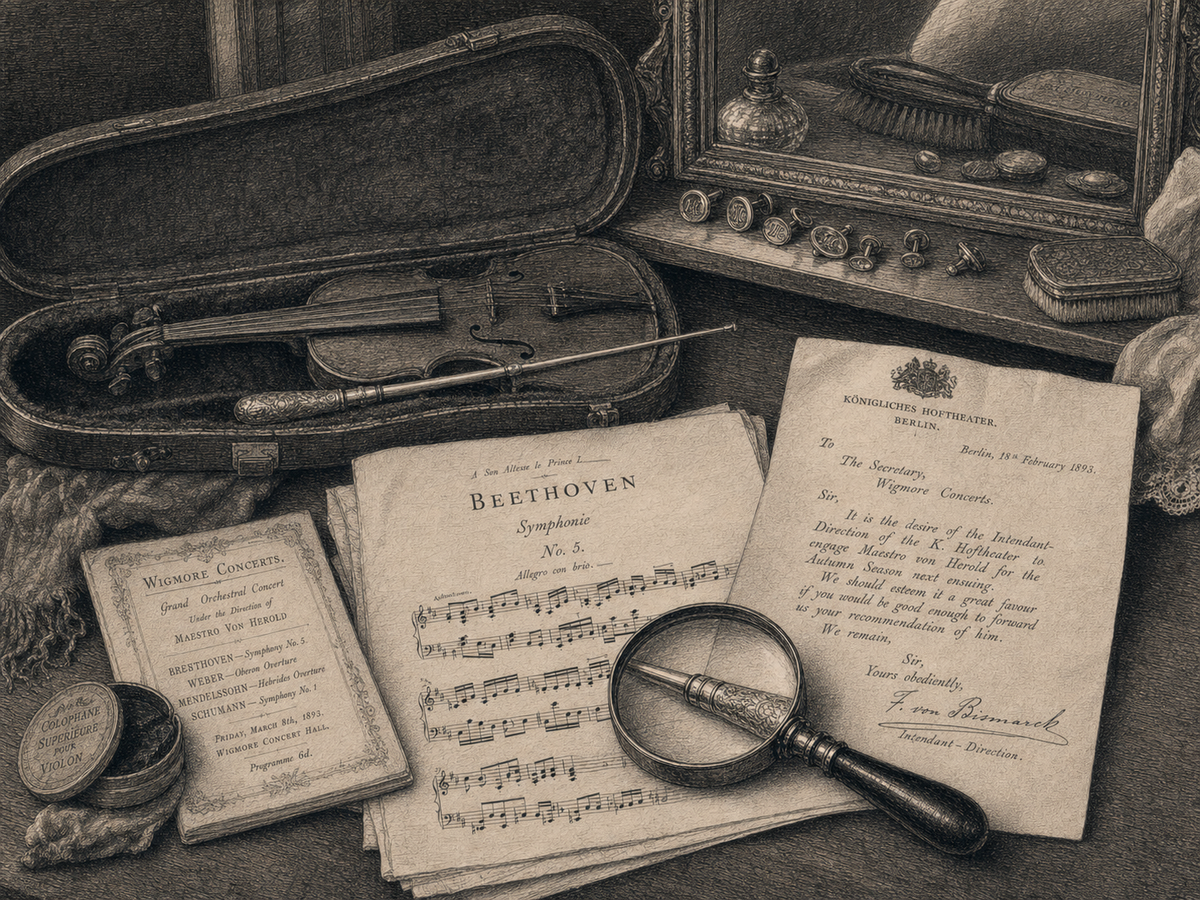
Engraved key object plate for The Case of the Conductor's Missing Baton.
Narrated by Dr Watson — the case as it stood before us
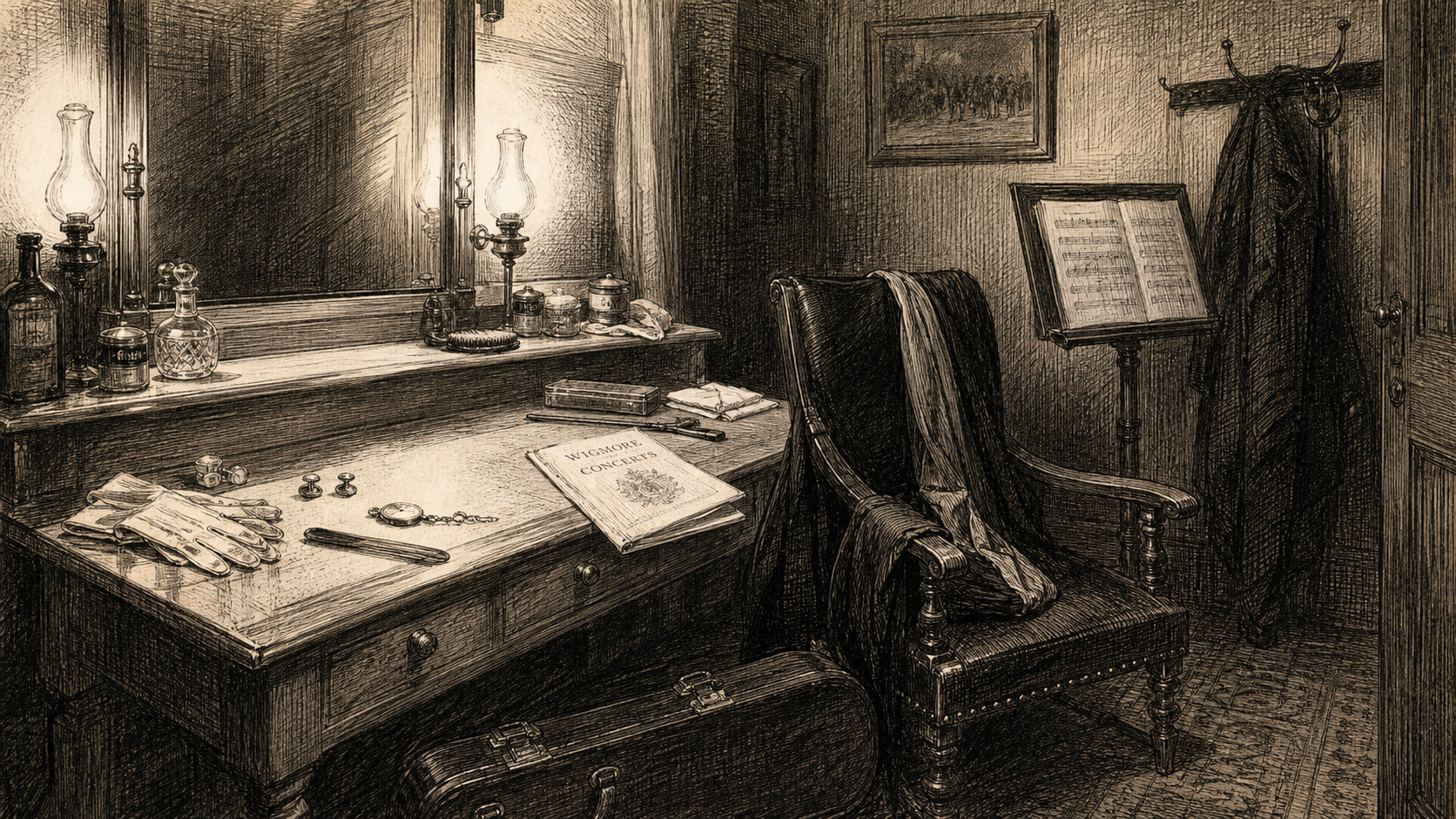
Victorian newspaper-style illustration for The Case of the Conductor's Missing Baton, set at Wigmore Concert Hall, dressing-room behind the stage.

Section I

The Scene

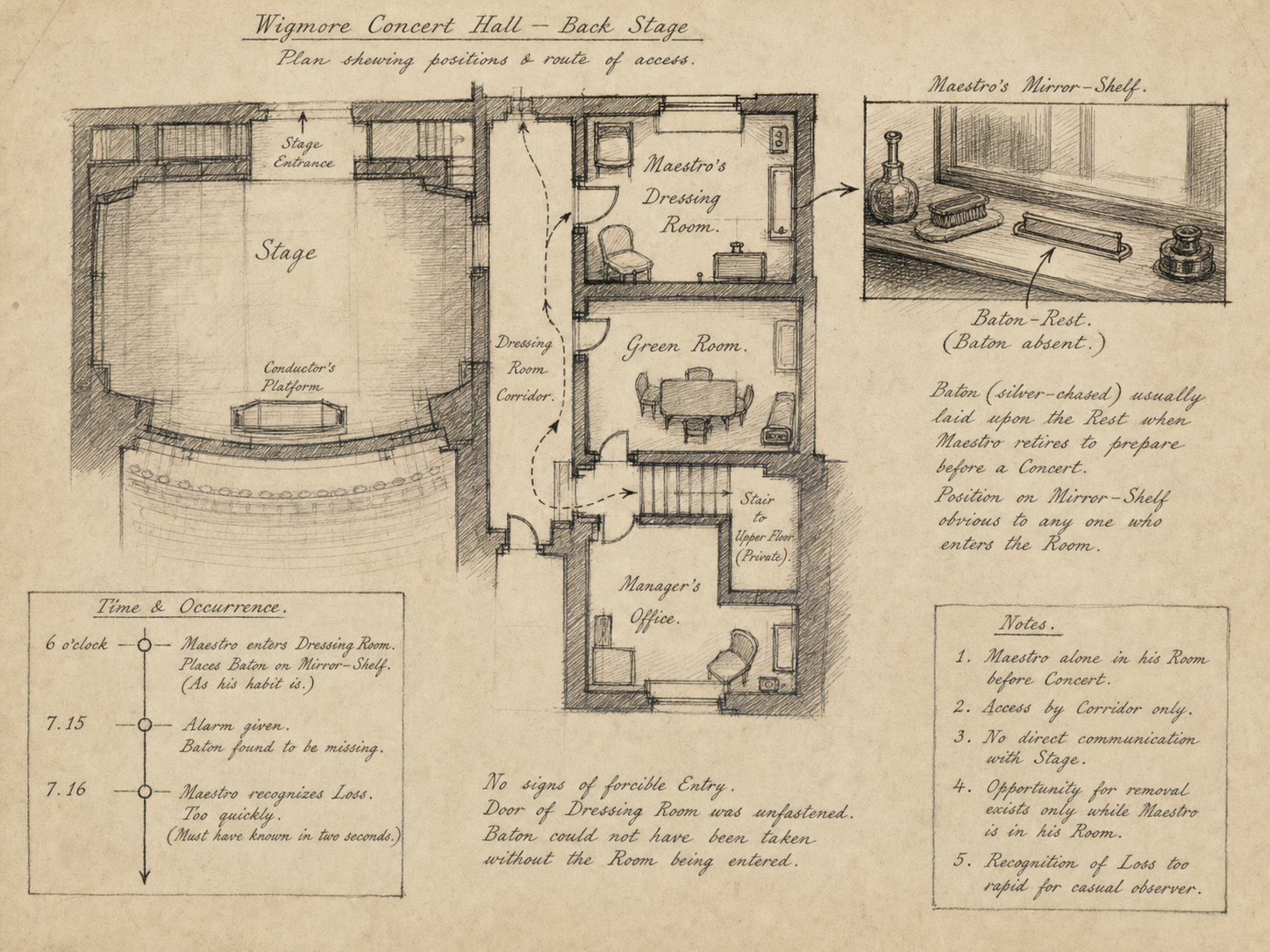
Hand-drawn case map for The Case of the Conductor's Missing Baton, showing Wigmore Concert Hall, dressing-room behind the stage.
The ground in question.
Setting
Wigmore Concert Hall, dressing-room behind the stage
Time
Tuesday evening, second Tuesday of May 1894
Weather
Mild; a fine evening; the orchestra audible from the platform above
Atmosphere
A small dressing-room scented with rosin and pomade; a mirror-shelf scattered with cuff-links; the orchestra's tuning-A persistent through the wall.

Section II

The Suspects

  • Maestro Pasquinelli

    Visiting conductor, Royal Italian Opera

    A florid, expansive Italian of fifty, much beloved on the platform and the recipient of the silver baton. He had no notion that the instrument might be missed; he had laid it by the mirror at six and left for the supper-room.

  • Mr Frede

    Deputy conductor

    A spare, ambitious Englishman of forty, who had said openly in the green room that the maestro was over-praised and that he could improve upon the second movement of the Bruch. If the maestro could not take the platform, the management's settled instruction was that Mr Frede would lead.

  • Herr Bauer

    Visiting first violinist, Berlin

    A neat, well-mannered German of forty-five, in London for the season at Pasquinelli's invitation. He had, that afternoon, defended the maestro at length to the press against Mr Frede's slights; he was negotiating, by post with Berlin, the maestro's autumn engagement at the Hoftheater.

  • Miss Tarn

    Dressing-room maid, six years at the hall

    A neat, unhurried woman of thirty-five, who had set out the maestro's dressing-room at five and had not returned until the alarm was raised. The dressing-room had been her sole charge that evening.

Section III

The Evidence

  1. The unlocked dressing-room

    The dressing-room had not been locked at six o'clock. The corridor outside it had been busy with stage-hands, choristers, and the orchestra moving up. The maid had been at the green room; the maestro had been at supper.

  2. Mr Frede's remark in the green room

    The deputy had been heard, that very afternoon, to say in the green room that he could improve upon the second movement of the Bruch and that the maestro was over-praised. His words had reached two stage-hands and the manager's secretary.

  3. Herr Bauer's afternoon at the Pall Mall

    Herr Bauer had spent his afternoon at the Pall Mall Gazette's offices defending the maestro, at length and unprompted, to a music critic who had not asked. The critic's notes show the defence to have been earnest and thorough beyond the occasion.

  4. Herr Bauer's discovery of the loss

    When the alarm was raised at quarter past seven, Herr Bauer was the first into the dressing-room — and within two seconds of entering, before any other man had glanced at the mirror-shelf, he said: "It is gone." He had identified the absence faster than any eye could have made the survey.

  5. Berlin correspondence

    A letter on the Berlin Hoftheater's stationery in Herr Bauer's coat-pocket, dated the previous Friday, requesting his urgent recommendation upon the maestro's autumn engagement — "if the gentleman's reputation does not suffer some uncharacteristic check between now and August."

Section IV

Statements & Testimony

  • Miss Tarn Reliable

    Dressing-room maid

    “"I set the room at five, sir. The baton was upon the shelf at six when I passed the door. I was at the green room from a quarter past, fetching the maestro's tea. Mr Frede was on the staircase from six to twenty past; I saw him there. The maestro was at supper. Herr Bauer came up the corridor at quarter past seven, just as the alarm was raised."”

  • Mr Lessage Partial

    Manager of the hall

    “"Herr Bauer has defended the maestro a great deal these last two weeks, Mr Holmes. To the press, to the trustees, to me. He has been the maestro's most ardent friend. It is to his great credit, I should think."”

Section V

Your Verdict

Three picks render a verdict. Name the culprit, choose the method, and nail the keystone clue. We score all three — partial credit if you got the culprit but missed the method, full credit only if you got Holmes’s exact reasoning.

1. Name the culprit
2. Choose the method

Which of these accounts of the deed best matches the evidence?

3. Pick the keystone clue

Of all the evidence above, which single piece nails the case?

Choose a culprit, a method, and a keystone clue to render your verdict.