The 221B Daily

A new edition from Baker Street every morning.

Sunday, 7 June 2026 | Difficulty IV

The Case of the Cape Town Letter

A letter arrives from Cape Town in a partner's hand. He drowned ten years ago. Now he claims his half of the firm.

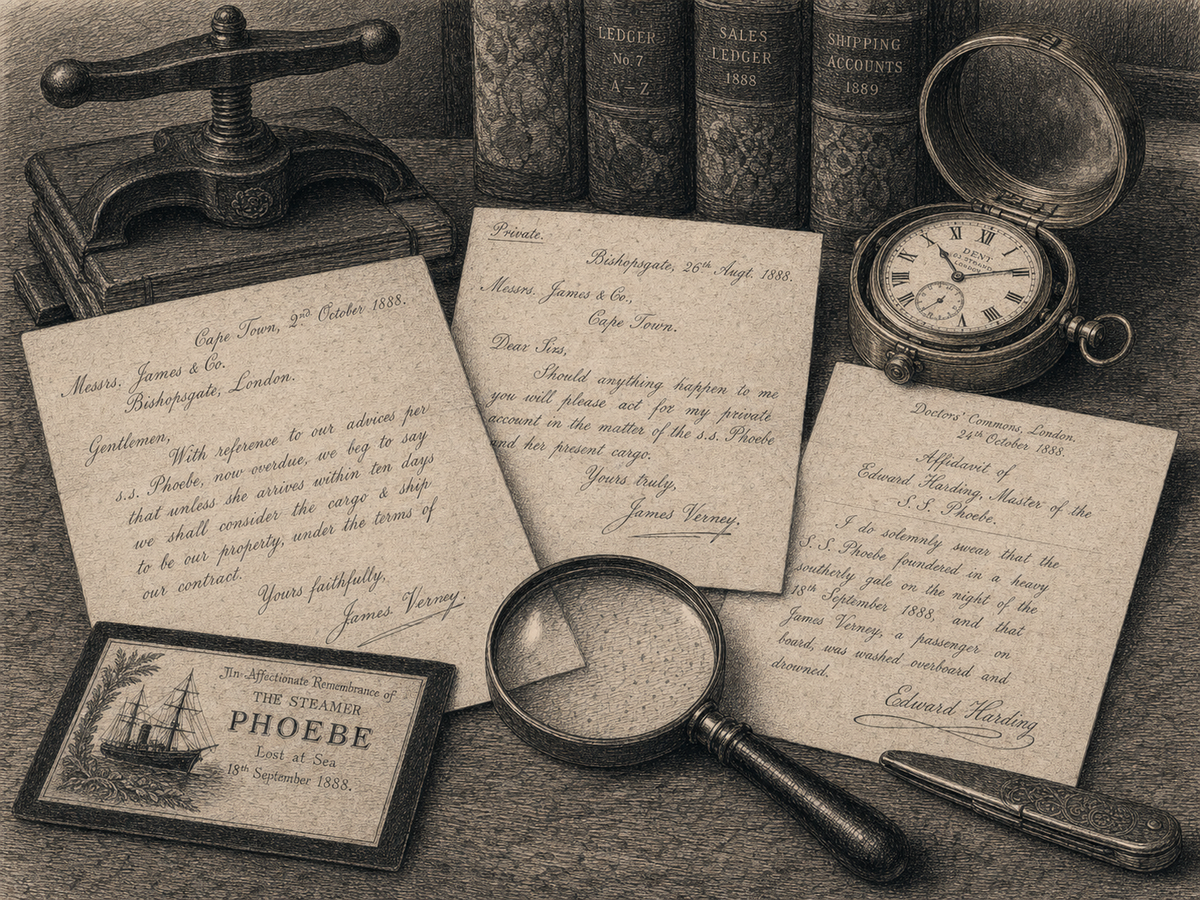
Engraved key object plate for The Case of the Cape Town Letter.
Narrated by Dr Watson — the case as it stood before us
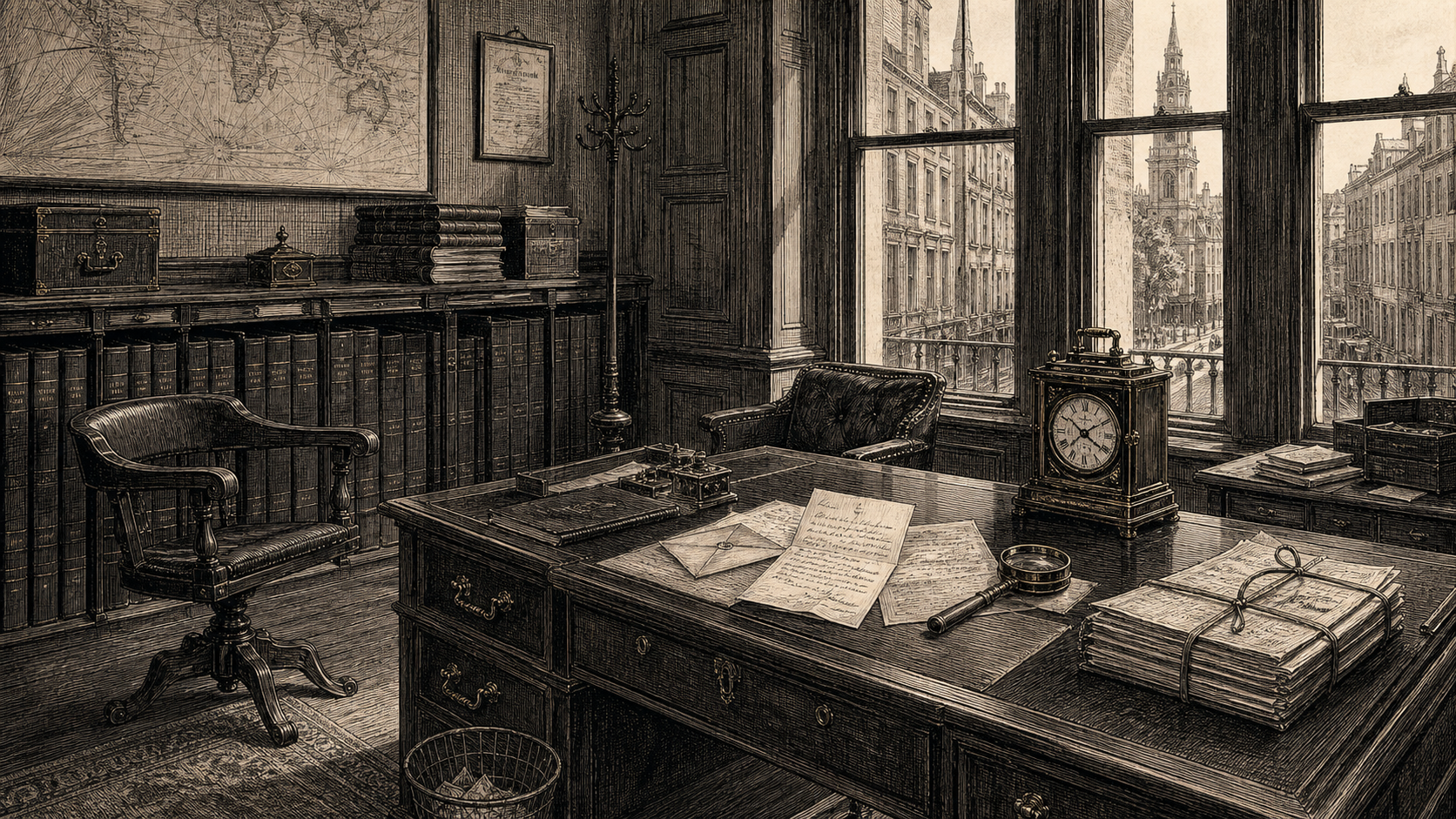
Victorian newspaper-style illustration for The Case of the Cape Town Letter, set at Lockyer & Tarrant, merchants, Bishopsgate, City of London.

Section I

The Scene

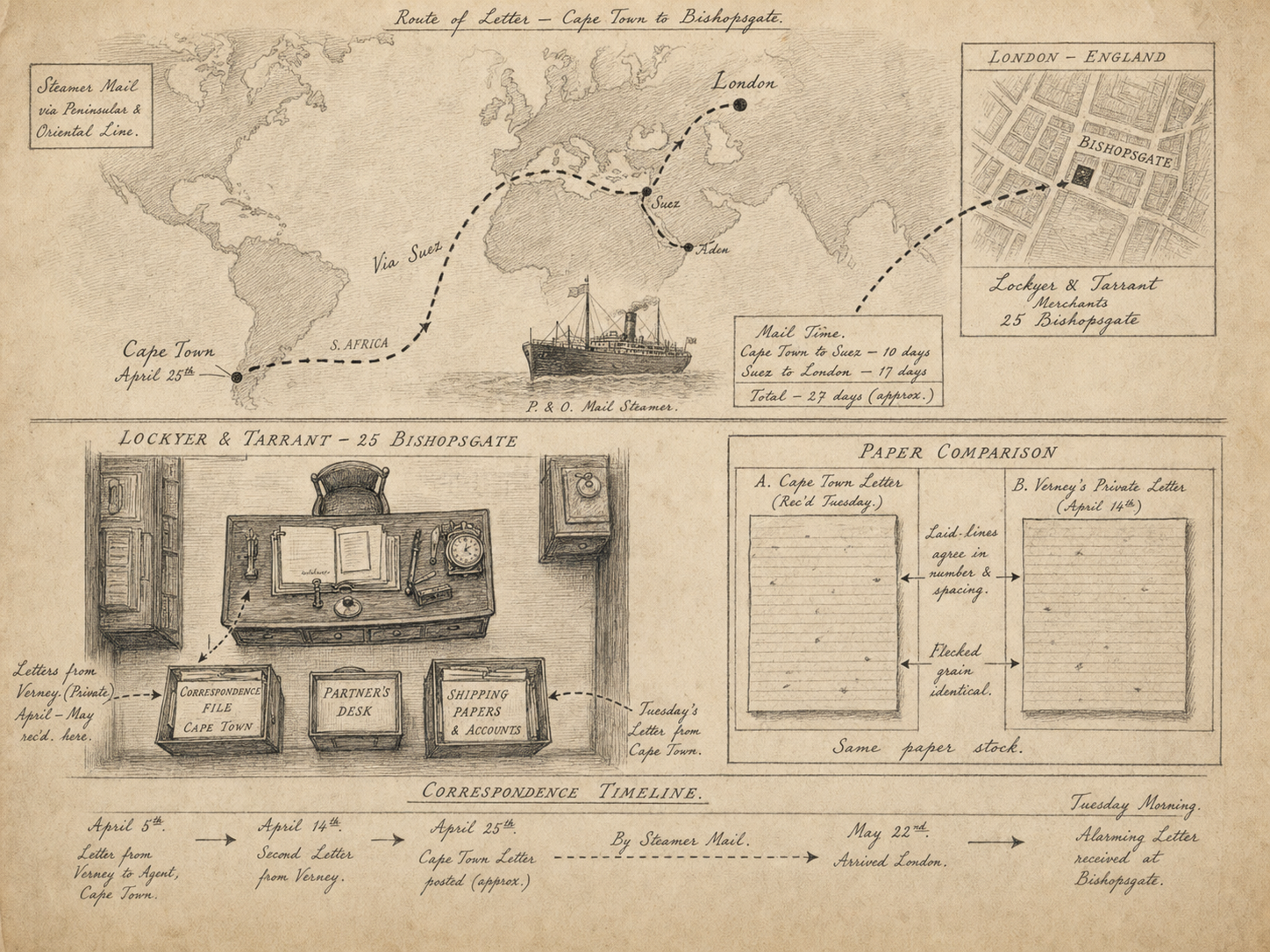
Hand-drawn case map for The Case of the Cape Town Letter, showing Lockyer & Tarrant, merchants, Bishopsgate, City of London.
The ground in question.
Setting
Lockyer & Tarrant, merchants, Bishopsgate, City of London
Time
Sunday morning, first Sunday of June 1894
Weather
Bright; a gentle breeze; church bells from St Helen's at half past ten
Atmosphere
A panelled merchant's-office, tall sash windows over a quiet Sunday street; ledger-presses along the inner wall; a brass-bound chronometer ticking on the partner's desk.

Section II

The Suspects

  • Mr Hugh Lockyer

    Surviving partner, the client

    A heavy, careful man of forty-five, who had run the firm alone these ten years. He had been generous to his elder brother's son and had taken him into the firm at fifteen. He had not, until last Tuesday's letter, doubted his brother's death.

  • Mr Verney Lockyer

    The drowned partner's son, raised by his uncle, the firm's junior man

    A clever, well-mannered young man of twenty-five, who had been raised in his uncle's house from the age of fifteen and had served the firm seven years as a clerk and now as junior man. He had, since spring, been a quieter and more abstracted figure than his uncle remembered.

  • Mr Pearce

    Bookkeeper, twenty-eight years in the firm

    A small, sandy-haired man of fifty, the keeper of the books, who had served the firm under both brothers and now under Mr Hugh. He had been recently dismissed for a small irregularity in the petty-cash and was bitter about it.

  • Mrs Lockyer

    Mr Hugh Lockyer's wife

    A composed woman of forty, who had loved her brother-in-law as a girl and had grieved him deeply. She had, on Tuesday morning, set the letter aside and refused to read it for a full day before laying it before her husband.

Section III

The Evidence

  1. The Cape Town letter

    A single sheet of cream paper, ruled and watermarked with a Cape Town stationer's name; the hand careful, period-formal, and resembling Edmund Lockyer's letters of '83 in every easy stroke. Holmes laid it under his lens and observed that the cream paper bore a particular laid-line and a flecked grain.

  2. Mr Verney's recent correspondence

    Holmes asked, with grave courtesy, for a sight of the firm's recent in-coming and out-going correspondence. Among the spring's letters was a private one from Mr Verney to a Cape Town shipping-agent, dated April. Under Holmes's lens the cream paper of Mr Verney's letter bore the same laid-line and the same flecked grain as the Cape Town letter of Tuesday.

  3. The captain's affidavit

    The captain of the rescue vessel had attested in '84 to recovering Edmund Lockyer's body from the surf at Mossel Bay. The affidavit was lodged with the firm's papers at Doctors' Commons.

  4. Mr Pearce's recent dismissal

    The bookkeeper had been put out of his place six weeks before for a discrepancy of three pounds twelve in the petty-cash. He had written letters to Mr Hugh threatening to make the matter known.

  5. Mr Verney's quiet spring

    Mr Hugh remarked that his nephew had been quieter through the spring; that he had spoken less of the firm's prospects; that he had taken to long walks alone on Sunday mornings. Holmes pressed him on the matter and Mr Hugh said only that he had supposed it a young man's natural reserve.

Section IV

Statements & Testimony

  • Mr Hugh Lockyer Reliable

    Surviving partner

    “"The hand is my brother's, Mr Holmes — I would swear to it. The phrasing is his. But Edmund is dead. The captain's affidavit is upon our papers; I attended his memorial service in '84. If he were alive he would have written sooner. I do not know what to think."”

  • Mrs Lockyer Partial

    Wife of the surviving partner

    “"I set the letter aside on Tuesday morning, sir. I would not look at it. It was Edmund's hand and Edmund is gone. Verney has been kind through the years; he is the boy I should have had if my own son had lived. I cannot speak ill of him."”

Section V

Your Verdict

Three picks render a verdict. Name the culprit, choose the method, and nail the keystone clue. We score all three — partial credit if you got the culprit but missed the method, full credit only if you got Holmes’s exact reasoning.

1. Name the culprit
2. Choose the method

Which of these accounts of the deed best matches the evidence?

3. Pick the keystone clue

Of all the evidence above, which single piece nails the case?

Choose a culprit, a method, and a keystone clue to render your verdict.